


supercharger


Senior Member
Joined: Sep 2005
Posts: 983
Likes: 0
From:
 RE: supercharger
That is theoretical compression ratio,not actual compression ratio. There is a major difference. The 2.3 has a short stroke and depends on valve timing and supercharger to achieve that.
no, that is ACTUAL. you got your "facts" all messed up. the REASON the hi compression works is because of the late INTAKE valve timing, and the compressor is necessary to keep the inlet charge from being forced back out. go read up on your basic miller cycle operation.
no, that is ACTUAL. you got your "facts" all messed up. the REASON the hi compression works is because of the late INTAKE valve timing, and the compressor is necessary to keep the inlet charge from being forced back out. go read up on your basic miller cycle operation.

Senior Member
Joined: Aug 2007
Posts: 1,324
Likes: 1
RE: supercharger
Miller Cycle is an interesting concept. Invented by American Ralph Miller rather than Mazda in 1940s, it changed the long-standing basic principle, Otto cycle. Conventional Otto cycle engines have 4 stages in each cycle - intake, compression, explosion (expansion) and exhaust. Each of them takes roughly equal time. Miller Cycle engine differs from it by delaying the inlet valves closing well into the compression stroke. What is the result of this ?
In Mazda's Miller Cycle V6 engine, inlet valves close at 47 degrees after BDC (bottom dead center, ie, the lowest position of piston during a cycle). This equals to 20% of the height of stroke. In other words, during the first 20% of the compression stroke, the intake valves remain opening, thus air flows out without compression. Real compression activated during the remaining 80% stroke. Therefore, the real effective capacity of the engine is only 80% of the volume of combustion chamber. Compression ratio is decreased from 10 : 1 to slightly under 8 : 1.
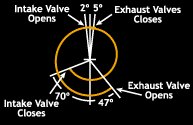 Valve timing of the Miller Cycle V6
Until now, you probably still don't understand its objective. Be patient, I am going to explain now.
Lower compression ratio means less energy loss in compressing air, i.e., the so-called "pumping loss". Moreover, lighter compression leads to lower temperature, thus reduces heat loss in cylinder wall and pistons. To compensate the reduction in real capacity, a supercharger is employed to increase the air density such that the engine actually resume 100% capacity. Of course, the supercharger must generates less pumping loss than those gain by reducing compression ratio. Otherwise Miller Cycle engine will be no more efficient than ordinary engines.
Note that the expansion stroke is the same as ordinary engines, it is not reduced like the compression stroke. As a result, power delivery and is as smooth as normally aspirated engines.
Disadvantage
Mazda's Miller Cycle engine burns 13% less fuel than its 3 litres conventional sister engine. It also generates more power and better torque curve. However, since its introduction in 1994 until now, no other car makers follow its trend. Even Mazda itself did not produce another Miller Cycle engine. Why ?
Think about it: although it is claimed to be a 2.3-litre engine, it is actually constructed as a 3-litre engine, no matter in dimensions and in material. Then, the supercharger and twin intercoolers (one per cylinder bank) will be extra cost compare with conventional 3-litre engine.
For a V6, this might be forgiveable, but those additional cost will be relatively expensive for a low cost four-cylinder engine. As a result, Miller Cycle concept can hardly be popular in the market.
[hr]
In Mazda's Miller Cycle V6 engine, inlet valves close at 47 degrees after BDC (bottom dead center, ie, the lowest position of piston during a cycle). This equals to 20% of the height of stroke. In other words, during the first 20% of the compression stroke, the intake valves remain opening, thus air flows out without compression. Real compression activated during the remaining 80% stroke. Therefore, the real effective capacity of the engine is only 80% of the volume of combustion chamber. Compression ratio is decreased from 10 : 1 to slightly under 8 : 1.
Valve timing of the Miller Cycle V6 Until now, you probably still don't understand its objective. Be patient, I am going to explain now.
Lower compression ratio means less energy loss in compressing air, i.e., the so-called "pumping loss". Moreover, lighter compression leads to lower temperature, thus reduces heat loss in cylinder wall and pistons. To compensate the reduction in real capacity, a supercharger is employed to increase the air density such that the engine actually resume 100% capacity. Of course, the supercharger must generates less pumping loss than those gain by reducing compression ratio. Otherwise Miller Cycle engine will be no more efficient than ordinary engines.
Note that the expansion stroke is the same as ordinary engines, it is not reduced like the compression stroke. As a result, power delivery and is as smooth as normally aspirated engines.
Disadvantage
Mazda's Miller Cycle engine burns 13% less fuel than its 3 litres conventional sister engine. It also generates more power and better torque curve. However, since its introduction in 1994 until now, no other car makers follow its trend. Even Mazda itself did not produce another Miller Cycle engine. Why ?
Think about it: although it is claimed to be a 2.3-litre engine, it is actually constructed as a 3-litre engine, no matter in dimensions and in material. Then, the supercharger and twin intercoolers (one per cylinder bank) will be extra cost compare with conventional 3-litre engine.
For a V6, this might be forgiveable, but those additional cost will be relatively expensive for a low cost four-cylinder engine. As a result, Miller Cycle concept can hardly be popular in the market.
[hr]
Senior Member
Joined: Sep 2005
Posts: 983
Likes: 0
From:
RE: supercharger
no, 10:1. i dont care if the valves are closed, open, missing, half open or what. the compression ratio is 10:1. with your incorrect theory, if the valves were gone, then the compression ratio would be 0. the COMPRESSION would be 0, but the compression RATIO would STILL be 10:1. change the cam timing, and it is an otto cycle. take away the compressor and it is STILL an otto cycle, with late intake valve timing. oh, and guess what? the compression ratio is STILL 10:1.
will the car run with a dead compressor? yup. of course, it will be down on power. how do i know? we have done 3 of them. which is way more than the other poster probably has even SEEN in their life.
will the car run with a dead compressor? yup. of course, it will be down on power. how do i know? we have done 3 of them. which is way more than the other poster probably has even SEEN in their life.

Thread
Thread Starter
Forum
Replies
Last Post


