


Modded M3


Thread Starter
Joined: Sep 2008
Posts: 4
Likes: 0
From:
 Modded M3
Hi all,
I just registered today, so please bear with me. (And I searched and browsed for about 30 min and didn't find what I was looking for, though being a newb here might account for that!)
I bought my 2007 Mazda3 Grand Touring back in March of 2008. It had about 16,000 miles on it, and I got it for around $19K. The sole owner was one of the dealer salesmen at the Mazda dealership, and he raced my car every weekend and made a few mods to it. (The car already had a new set of tires on it when I bought it!) He told me the car now hit 172 HP at 6300 RPMs, and that he couldn't get it to go faster than 130 mph. (I really have no clue but just repeating what he told me.)
Anyway, the mods he made were a Mazdaspeed CAI, a custom free flow exhaust (have no idea make/model), and a performance clutch. Now, this is all fine and dandy, as I love any enhancements that might improve my zoom-zoom experience. But, I have some complaints and need some advice.
First, the exhaust is WAY loudthe quintessential "fart can" sound. And while it sounds pretty cool when I'm gettin' on the gas, that doesn't outweigh the annoyance of the sound when just cruising down the highway. (Being 40 years-old, it's a little embarrassing, actually!) What would be the cheapest and easiest way to reduce this noise, in your esteemed opinions?
Secondly, the performance or "racing" clutch is the most difficult manual clutch I've ever driven. I've been driving sticks since I was 16Fiats, Toyotas, and Hondasand this clutch is the most difficult to master. I find myself either popping it, inadvertently, barking the tires, or damn-near stalling out. Is there some trick to driving with this type of clutch (foot position, etc.)? I would really appreciate any advice you fine folks can offer. (I'm a computer/electronics geek, not a car guy.)
Thanks again for enduring my long post, and kudos to this forum and the folks who make it such a helpful community.
I just registered today, so please bear with me.
(And I searched and browsed for about 30 min and didn't find what I was looking for, though being a newb here might account for that!)I bought my 2007 Mazda3 Grand Touring back in March of 2008. It had about 16,000 miles on it, and I got it for around $19K. The sole owner was one of the dealer salesmen at the Mazda dealership, and he raced my car every weekend and made a few mods to it. (The car already had a new set of tires on it when I bought it!) He told me the car now hit 172 HP at 6300 RPMs, and that he couldn't get it to go faster than 130 mph. (I really have no clue but just repeating what he told me.)
Anyway, the mods he made were a Mazdaspeed CAI, a custom free flow exhaust (have no idea make/model), and a performance clutch. Now, this is all fine and dandy, as I love any enhancements that might improve my zoom-zoom experience.
But, I have some complaints and need some advice.First, the exhaust is WAY loudthe quintessential "fart can" sound. And while it sounds pretty cool when I'm gettin' on the gas, that doesn't outweigh the annoyance of the sound when just cruising down the highway. (Being 40 years-old, it's a little embarrassing, actually!) What would be the cheapest and easiest way to reduce this noise, in your esteemed opinions?
Secondly, the performance or "racing" clutch is the most difficult manual clutch I've ever driven. I've been driving sticks since I was 16Fiats, Toyotas, and Hondasand this clutch is the most difficult to master. I find myself either popping it, inadvertently, barking the tires, or damn-near stalling out. Is there some trick to driving with this type of clutch (foot position, etc.)? I would really appreciate any advice you fine folks can offer. (I'm a computer/electronics geek, not a car guy.)
Thanks again for enduring my long post, and kudos to this forum and the folks who make it such a helpful community.

Super Moderator
Joined: Mar 2007
Posts: 8,666
Likes: 0
From: Manor, TX (Outside of Austin)
RE: Modded M3
First of all, it sounds like you bought the wrong Mazda3 for your needs, but since you did, find out EXACTLY what was done to the car. What parts were removed and replaced, and what parts were simply removed.
It sounds to me like you have a stage II or stage III clutch in there (probably a Stg II,) which are not truly intended for every day street driving. The engagement and take-up will be a little rude no matter what you do.
Does the car still have the catalytic converter and the pre-cat? Does it have a header system? Did he retain ANY muffler or resonator in the "new" system? Did he install a lightened flywheel when he did the clutch? Which one? There are 3 that I am aware of: The Mazdaspeed sold one, 16lbs; TheExedy, 12lbs; and for all out drag racing, the Findazia @ 8lbs.The lighter the flywheel and the stiffer/harder the clutch, the less streetable the car will be.
I would say you have a lot of questions for this seller, Lee, and if possible sell it back to him and get a new stock one for nearly the same money. 19K is not such a good deal on this one, IMO, especially since he raced it. And I assume by "racing" it, you mean that he was an avid auto-crosser? Did he replace the brakes and at least resurface the rotors before he sold it to you?
It sounds to me like you have a stage II or stage III clutch in there (probably a Stg II,) which are not truly intended for every day street driving. The engagement and take-up will be a little rude no matter what you do.
Does the car still have the catalytic converter and the pre-cat? Does it have a header system? Did he retain ANY muffler or resonator in the "new" system? Did he install a lightened flywheel when he did the clutch? Which one? There are 3 that I am aware of: The Mazdaspeed sold one, 16lbs; TheExedy, 12lbs; and for all out drag racing, the Findazia @ 8lbs.The lighter the flywheel and the stiffer/harder the clutch, the less streetable the car will be.
I would say you have a lot of questions for this seller, Lee, and if possible sell it back to him and get a new stock one for nearly the same money. 19K is not such a good deal on this one, IMO, especially since he raced it. And I assume by "racing" it, you mean that he was an avid auto-crosser? Did he replace the brakes and at least resurface the rotors before he sold it to you?
Super Moderator
Joined: Mar 2007
Posts: 8,666
Likes: 0
From: Manor, TX (Outside of Austin)
RE: Modded M3
Oh, 2 other things:
1) How did he get past the electronic speed limiter of 118mph to get the car to 130?
2) Is that new HP figured @ the flywheel or at the driven wheels? 172 is a pretty big increase... especially for the mods you've mentioned.
I'd want to see a dyno sheet to confirm that. Also keep in mind that many factors come into play when dynoing a car or it's engine. Ambient temperature, barometric pressure, the guy runningthe controls and interpreting the information, the software and even the machine's manufacturercan all factor into the final numbers.
Take you car to one place, do 3 runs, then take it to another on the same day in the same geographic location and you'll have a different set of numbers.
See what I mean?
1) How did he get past the electronic speed limiter of 118mph to get the car to 130?
2) Is that new HP figured @ the flywheel or at the driven wheels? 172 is a pretty big increase... especially for the mods you've mentioned.
I'd want to see a dyno sheet to confirm that. Also keep in mind that many factors come into play when dynoing a car or it's engine. Ambient temperature, barometric pressure, the guy runningthe controls and interpreting the information, the software and even the machine's manufacturercan all factor into the final numbers.
Take you car to one place, do 3 runs, then take it to another on the same day in the same geographic location and you'll have a different set of numbers.
See what I mean?
Thread Starter
Joined: Sep 2008
Posts: 4
Likes: 0
From:
RE: Modded M3
Virg, thanks for all of the input. Wow. I probably need a dictionary to translate some of that, as I don't know the lingo!  At any rate, I'll try to give you some more info.
I bought the car from the Spartanburg, SC Mazda dealership. One of the salesmen there was the one who modded it. I live in Tampa, FL now, so I can't just stop by and ask him what he did. I will try and get in touch with him via email, though. (Would my local Mazda dealer be able to look at and tell me what isn't factory on it?) Oh, and I have no idea how he figured out the HP, and he said he "raced it every Saturday night". I don't know if that means legally or illegally!
The car is in seemingly very good shape. (They sold me the car for around $16.5K, but my credit is horrible, so $19K is what I owe. ) Honestly, I love it except for the performance muffler and clutch. I just had the brakes checked out, and they are in great shape. And, I know I can get a new muffler, but he mentioned something about having a resonator put on? What is that?
And as far as the clutch, what exactly is the point of a Stage 2 clutch? What is the benefit?
I appreciate your patience with me!
-Lee
At any rate, I'll try to give you some more info.I bought the car from the Spartanburg, SC Mazda dealership. One of the salesmen there was the one who modded it. I live in Tampa, FL now, so I can't just stop by and ask him what he did. I will try and get in touch with him via email, though. (Would my local Mazda dealer be able to look at and tell me what isn't factory on it?) Oh, and I have no idea how he figured out the HP, and he said he "raced it every Saturday night". I don't know if that means legally or illegally!
The car is in seemingly very good shape. (They sold me the car for around $16.5K, but my credit is horrible, so $19K is what I owe.
) Honestly, I love it except for the performance muffler and clutch. I just had the brakes checked out, and they are in great shape. And, I know I can get a new muffler, but he mentioned something about having a resonator put on? What is that?And as far as the clutch, what exactly is the point of a Stage 2 clutch? What is the benefit?
I appreciate your patience with me!
-Lee
Super Moderator
Joined: Mar 2007
Posts: 8,666
Likes: 0
From: Manor, TX (Outside of Austin)
RE: Modded M3
A stage II clutch... hmmm, that's gonna be a hard one to explain to someone that has little/no knowledge of a clutches make-up.
A clutch is made up of 3 parts, 4 if you include the flywheel which certainly has to be there for it to work. A pressure plate, the disk and a throw-out bearing. The throw out is simply the method the clutch is engaged by. You step on the pedal and a linkage, cable or in our case a hydraulic cylinder forces the bearing forward into the pressure plates spring structure.
The pressure plate provides the clamping force to the flywheel and that allows powered motion. It houses the spring structure for the clamping force which connects to a flat surface that presses the disk against the flywheel.
The disk has the "soft" material on it that is designed to destroy itself over time, like brake shoes/pads. This is the go-between between the flat surface of the flywheel and the flat surface of the pressure plate. It has a set of springs also, but they are designed to smooth "take-up" so that when you launch these provide a cushion and the launch is not as brutal.
Here's a picture of your average street (OE) or stage I clutch:
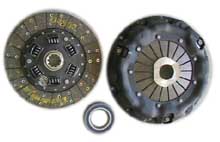
OK, that said,A stage I or II clutch is designedto handlemore power and with a harder engagement. A better, faster launch as well as much higher clamping force. Higher force= less power loss through the drive train.
Therefore, a performance clutch has greater clamping force and usually less or harder"take-up" springs, which seems to me what you are experiencing.
Here are some other pics. The first is a typical stage II. The second is a typical Stage III or IV. Notice that this one has NO take-up springs and only 4 "puck" surfaces (some others have 6) that contact the flywheel and the pressure plate. THAT's a hard launch


BTW: To identify the parts for you, clockwise from upper left to lower right:
1) Pressure plate (in yellow.) 2) A "line up" or alignmenttool. Used for installation only. 3) The throwout bearing. 4) the pilot bearing, sometime a bushing (fits into the back of the crankshaft to support the trans input shaft and keep the disk supported and aligned, and 5) the clutch disk.
A clutch is made up of 3 parts, 4 if you include the flywheel which certainly has to be there for it to work. A pressure plate, the disk and a throw-out bearing. The throw out is simply the method the clutch is engaged by. You step on the pedal and a linkage, cable or in our case a hydraulic cylinder forces the bearing forward into the pressure plates spring structure.
The pressure plate provides the clamping force to the flywheel and that allows powered motion. It houses the spring structure for the clamping force which connects to a flat surface that presses the disk against the flywheel.
The disk has the "soft" material on it that is designed to destroy itself over time, like brake shoes/pads. This is the go-between between the flat surface of the flywheel and the flat surface of the pressure plate. It has a set of springs also, but they are designed to smooth "take-up" so that when you launch these provide a cushion and the launch is not as brutal.
Here's a picture of your average street (OE) or stage I clutch:
OK, that said,A stage I or II clutch is designedto handlemore power and with a harder engagement. A better, faster launch as well as much higher clamping force. Higher force= less power loss through the drive train.
Therefore, a performance clutch has greater clamping force and usually less or harder"take-up" springs, which seems to me what you are experiencing.
Here are some other pics. The first is a typical stage II. The second is a typical Stage III or IV. Notice that this one has NO take-up springs and only 4 "puck" surfaces (some others have 6) that contact the flywheel and the pressure plate. THAT's a hard launch
BTW: To identify the parts for you, clockwise from upper left to lower right:
1) Pressure plate (in yellow.) 2) A "line up" or alignmenttool. Used for installation only. 3) The throwout bearing. 4) the pilot bearing, sometime a bushing (fits into the back of the crankshaft to support the trans input shaft and keep the disk supported and aligned, and 5) the clutch disk.
Super Moderator
Joined: Mar 2007
Posts: 8,666
Likes: 0
From: Manor, TX (Outside of Austin)
RE: Modded M3
Oh, and a resonator is sort of a muffler... straight through design that stratigically placed in the system to help reduce or eliminate secondary harmonics (droning.) http://vibrantperformance.com/catalo...ff6074a0eaabe1


Senior Member
Joined: Mar 2007
Posts: 1,672
Likes: 0
From: houston
RE: Modded M3
i will help you out with the clutch thing. the racing clutches are generally lighter and made of a harder, more durable material. they are also "pucked" rather than solid to save weight. if he went through the trouble to do the clutch, i am sure that he did the flywheel also. this contributes to the same lightening process as the clutch. it also contributes to the same effect. the motor now has less rotating mass since the clutch and flywheel are lightened. this means that the motor has less centrifugal force to keep it moving. that explains why it is you are either barking the tires or jumping the clutch. when you add to that the power added to the car, you need to consider how much harder the car will be to drive now.

Thread
Thread Starter
Forum
Replies
Last Post
UseYourNoggin
Mazda Miata (MX-5)
1
Jan 29, 2014 02:34 AM
